When I was four years old, I spent much of my days adventuring in the overgrown backyard at my babysitter’s house in Richmond Beach. While she kept her front yard reasonably trimmed, the half-acre behind the house had been reclaimed by nature after decades of neglect. Carol’s husband had died when her children were still young, and her kids had advanced to varying degrees of adulthood. In all that time, no one had paid any attention to the backyard, which meant that it was a place of wonder and amazement for a little kid like me.
Rusty pieces of old cars were being strangled by unfettered grass and blackberry stalks. Buckets, empty engine oil containers, squeaky bed springs, soggy scrap wood, and various hand tools could be discovered by rooting around underneath the canopy of feral grass. There was a giant wooden spool once used for cable that I could climb up on and move across a concrete slab like a log-roller. Piles of junk that were probably once assembled of useful items that may one day come in really handy were now protruding from the greenery like volcanic islands–the blue tarps that once covered them having long since weathered to ribbons.
For a kid whose prized possessions included a rock with sparkles in it and several metal pieces to unknown mechanisms (if it was weighty, shiny or metal, it was automatically very valuable indeed), climbing around among the detritus offered endless opportunities to marvel at the industriousness of man, and to covet his collected treasure.
The driveway led from the street along the side of the house to the backyard, terminating at a one-car garage—the doors of which I’d never seen open, and could only be chock-full of more treasure. Parked in front of that garage was a 2-ton wheat truck that never moved. I was too small to climb into the back of it, but I could climb up and stand on the running-boards if I held onto the door handle; and I could pretend that I was a fireman on the way to save the lives of trapped people or curious if dumb housecats.
The truck was parked underneath a pine tree and was surrounded by years’ worth of fallen pine needles like brown snowdrifts that provided a soft landing when, every couple of minutes, I lost my grip and fell off the side of the truck.
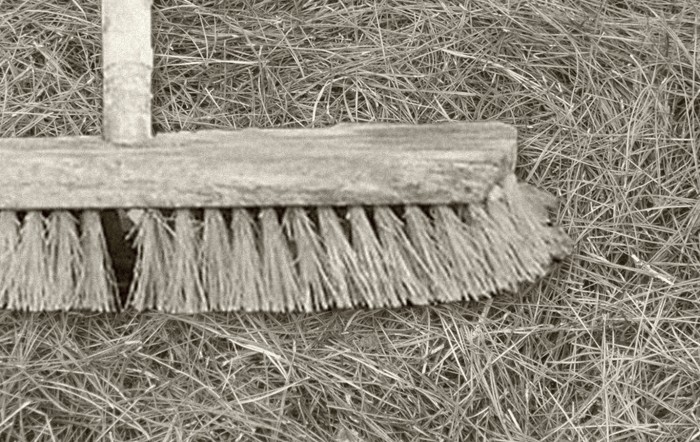
On one particular summer afternoon, after finding a screwdriver and a broken hose nozzle (i.e. a dagger and a laser gun), I started exploring the narrow space between the garage and the fence that separated Carol’s yard from her neighbor’s. Behind a set of old tires, I discovered a cracked and crusty push broom. I dropped the screwdriver and nozzle on the ground and dragged the broom out onto the driveway.
We didn’t have a broom like this at my house; we just had a regular upright broom that my mom used to sweep the kitchen. Our driveway, patio and walks were kept clean with the aid of a garden hose. This new configuration was fascinating, and I started trying it out on the inches of pine needles covering the cement. It was clumsy and ineffective using it like our kitchen broom, but I quickly discovered how great it was if I pushed debris away from me instead of pulling it toward me. The pine needles were dry and gathered into impressive piles, leaving behind swaths of clean concrete.
I was completely absorbed. Every stroke revealed more of the driveway and the pile of pine needles grew. There was no clear stopping point, and my work area grew to include more and more square footage. I was having a ball, thinking through the logistics of building my brown mountain taller rather than wider, widening my area of focus to gather more material, and seeing the driveway transform by degrees. I pushed needles from underneath the truck and from around the tires. I pushed needles from the patch of dirt that must have been a flowerbed in the distant past. I pushed needles from around the garage door, from the far side of the truck, and began working my way down the slope of the driveway, pushing all the refuse into one impressive monolith. It was glorious.
Then I was startled by a loud voice.
“Oh, thanks a million!” Carol shouted from the kitchen door. That was her phrase, thanks a million. Thanks a lot or thank you very much just didn’t have the punch of thanks a million. I about jumped out of my skin, being forcibly yanked from my zone of hyper-focus. “If you finish the driveway, I’ll pay you two dollars!” she added with excitement in her eyes and teeth in her grin.
Two dollars! I didn’t know how much candy that would buy me, but I bet it was a lot. M&Ms were only 40¢ in those days, and so were Big Hunks. You could get Jolly Ranchers (sold in sticks back then) for a dime. What you must be able to get for two dollars was unfathomable for a four-year-old. Two dollars! I agreed.
But, you know what? I hated every damn minute of the task after it was cheapened by financial compensation. Suddenly, it wasn’t childish fun anymore; it was work. Instead of for my own satisfaction, I was now laboring for someone else’s; and placing expectations, requirements and a dollar value on my playtime activity instantly transformed it into a chore. Even daydreaming about two dollars’ worth of candy couldn’t make up for how much I loathed sweeping the pine needles now. I just wanted to drop the broom and play with the screwdriver and broken hose nozzle I’d found earlier. I wanted to go roll the giant wooden spool around. I wanted to go bounce on the rusty bed springs. I wanted to go find out what I could see through the broken slat in the far back fence. I wanted to do anything but sweep the fucking pine needles.
There have been a bunch of psychological studies examining the difference between work and play. One way to frame the topic is by looking at the difference between exntrinsic and intrinsic motivation. Intrinsic motivation causes us to do things because we find them personally rewarding, interesting or fun, while extrinsic motivation causes us to do stuff to gain an external reward like a paycheck or to avoid a negative outcome like a reprimand. While extrinsic motivation can definitely encourage someone to perform a task that they wouldn’t have done otherwise, offering an external reward for something someone was already interested in can actually kill their intrinsic motivation. This is known as the overjustification effect.
Imagine going home with someone you find crazy attractive, having really great sex, and then being handed two hundred dollars as a thank-you. Kind of spoils it, huh?
There’s an old adage, “Find what you love to do, and you’ll never work another day in your life.” That’s bullshit. It may be true to a certain extent (if what you love is making money), but say you love landscaping, get a job for a landscaper, and then hear all day: “When are you going to be done with that flowerbed? What’s taking so long? We’re falling behind schedule. Make sure you use the dark bark, not the light stuff, and don’t forget to clean the truck out when you’re done with it. We’re going to try to squeeze one more job in today, but don’t worry, you’ll get overtime pay.” I doubt you’d find it as enjoyable as sculpting that kaffeeklatsch nook in your own front yard.
The Montessori education model makes good use of intrinsic motivation by allowing children to perform the activities they’re interested in, which keeps them engaged and helps them learn. Likewise, the most rewarding jobs I’ve had were certainly not the ones that paid the best, but rather the ones that allowed me to set my schedule and pursue my interests within the company, which not only kept me intensely engaged, but also had a big impact on the company.
A couple of years after the sweeping incident, when I was about six years old, I got my first “regular job.” Mr. Miller was a kind old man who lived down the street from my house. He was always tinkering in his garage-turned-workshop, which was crammed to the rafters with a lifetime of treasures. I would often stand just outside the garage door peering in, and he’d talk to me about boating, woodwork or whatever else was on his mind. Mr. Miller asked my parents for permission to “hire” me to come to his house once a week to do some small task in exchange for a dollar. His wife gave my sister art lessons, and I think Mr. Miller wanted some company, too.
My first afternoon of work consisted of painting a rusty 55-gallon burning barrel with some old silver paint he’d found in his workshop. I still considered shiny, metallic things inherently valuable, so painting the barrel silver felt like I was the runner-up in the Midas Touch Olympics. When some of the paint got onto the lawn, I picked individual blades of grass, showed them to Mr. Miller and we marveled together over my skill in alchemy. Mr. Miller let me work at my own pace and took pride in my sense of discovery. He encouraged investigation and wonder, and didn’t loom over me to make sure the job was being done “right.” I had so much fun that it was often a surprise when he’d fish a dollar out of his wallet and hand it to me before I went home. The money felt more like an unexpected gift than compensation for my work.
To this day, when I’m working, I try to forget about the obligation of it all and the monetary reward. Instead, I focus in on the task at hand and take pleasure in the planning and execution of it. I find zen in the repetition, reward in the observable progress, and intellectual stimulation in the formulation of strategy and re-calibration due to unforeseen obstacles. Basically, I try to play at work.
If I could have temporarily forgotten about that cursed two dollars when I was four years old and sweeping pine needles, if I could have separated the task from the reward, I would have had a ton of fun pushing the broom all afternoon, and I still would have enjoyed a bunch of candy at the end of the day. That would have been the best day ever.