Once in a while, I start going through the files on my computer the way people browse through photo albums. I begin to read old shit I’ve written (quite seriously, most of it is shit), and I imagine (more than remember) what was going on in my life when poetry and prose was scrawled into notebooks and then transcribed into digital immortality. Occassionally, I find a diamond in the rough, something that triggers an emotional response and causes me to pause quietly to consider it for a while.
Below is one such document. This was written a few years ago…
* * *
My grandfather is dead. At least, that’s what I hear through the family’s tortuous gossip chain. He died a year or two ago, I think. I can’t say with certainty; I didn’t go to the funeral, or the memorial service, or whatever it is they do these days. I remember my grandfather saying, “If people don’t care enough to come and see me while I’m alive, then I sure as hell don’t want them coming to see me when I’m dead.” So, I didn’t go. I thought that I could at least pay him that respect.
See, the thing about a memorial service, or what I gather the name implies, is that it’s supposed to be for the purpose of remembering the super-terrestrial history of the person being lowered into the ground. There’s not a lot I remember, though, because we were never really a part of each other’s lives.
I can’t say we ever had much of a relationship. My sister and I did not refer to my grandparents as “Grandpa Dale and Grandma Kay,” the way other kids do. They were “Grandpa and Grandma Haugen” to us by way of differentiating them from my mother’s parents. Dale was always Grandpa Haugen, with all the formality of calling him Mr. Haugen. And there you have my last name, though I feel no connection to its obscure lineage.
I’ve always thought that there was a large disparity between him and me. I’ve always assumed that he and I would have the same irreconcilable differences that I have with the rest of my relatives, but now I realize that I have little evident support for such assumptions. I actually don’t even know if he was a Republican or a Democrat. I always saw him as a conservative by extension of his personality (he’d tell distasteful jokes about “spics” or relay stories about “jewing” a guy down on the price of something, and to this day, it makes me grimace), but did he ever work for labor unions? How did he feel about the national debt or the budget deficit? I have vague recollections of him using both the names Tricky Dick and Slick Willy, so it’s hard to say on which side of the political divide he fell.
My grandfather was a Lutheran, but he was never overbearingly religious like the evangelicals I’ve come to detest. I don’t know if he knew anything about Martin Luther, or the 99 Theses, or the first translation of the Bible out of Greek and Hebrew or Latin (Luther translated it into German to the Roman Catholic Church’s horror). He’d listen to Billy Graham on the radio on Sunday mornings, and he’d have had his fill of religion for the week. He’d make disparaging comments about the “holy-roller” churches my family attended when I was growing up, but while it was an affront at the time, now I’d have to agree with him.
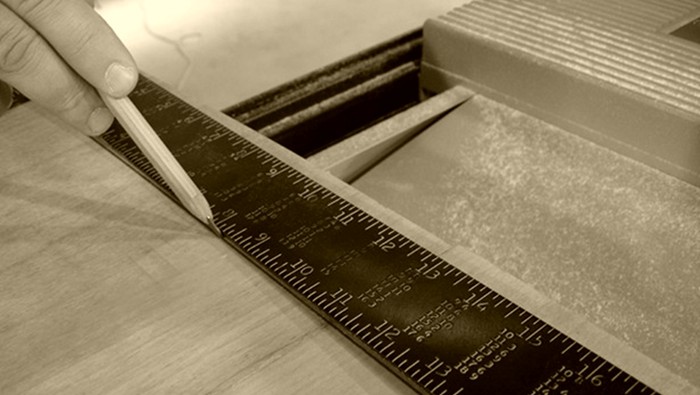
On a personal level, I hardly knew the man. There is more void than memory. But, I surprise myself sometimes, quoting my heart-of-America grandfather while telling some urban-liberal anecdote. Even in the workplace, I’ll find myself teaching a lesson that I ascribe to my grandfather; though with no memory in sepia of some tutorial moment, he may well have taught me by means of mere genetic coding. “Measure twice. Cut once.” That’s what he taught me. I think at one point in his life, he worked in the building trades. This adage comes from cutting lumber for construction purposes. You see, you can’t uncut a board. I’ve taken that piece of wisdom with me into my life; when something can’t be undone, it’s best to “measure” several times before acting.
Dale was not a lighthearted, carefree, or even affectionate man. I have only one memory of him interacting with my sister and me in a playful manner. She and I were singing the theme song to “Chip and Dale,” the little cartoon rodents. We’d sing, “I’m Chip, I’m Dale…” and he’d interject, “No, I’m Dale.” We’d burst into laughter, and start again. “I’m Chip, I’m Dale…” “No, I’m Dale.” I don’t think we even knew the rest of the song, but it didn’t matter, because he’d interrupt before we’d get there, and we’d be in stitches.
Still, I can recall him laughing. Starting out with a “heh heh heh”, in seconds he’d be hunched forward in his chair with a wheezing cough that would deprive him of air, make his face and oversized ears glow a vivid red in contrast to his white–though yellowing from lack of attention–hair. Every time he had one of his coughing fits, I thought he was going to die. Very little of his lungs still worked. He said that it was because of asbestos exposure while he was in the military, but even as a child, I’d have been willing to bet that it was due to four packs of Camel Unfiltered cigarettes a day since he was twelve years old. (Later in life, when he could only afford Basic cigarettes, he’d snap off the filter, mumbling, “There’s no sense having a tampon on the end of a cigarette.”) But, what did I know, I was just a kid.
That was how I knew him, sitting in his chair at the kitchen table, staring out the window to the thermometer hanging outside, and smoking his cigarettes. He’d be up at five in the morning, and in his chair until seven in the evening when he’d go to bed. His whole day would be spent in that kitchen, unless he donned his coat and went outside to “fix” his small fishing boat that rarely saw the water. (I don’t think it was ever broken, and if so, would have been beyond repair.) Dale would listen to AM talk radio. He loved Paul Harvey, though he would never comment on those monologues. He’d smoke his cigarettes, suck on generic cough drops, and drink coffee. In his last years, an oxygen tank was added to his routine. Cigarettes, coughing attack, oxygen, cough drops, coffee and repeat. Periodically, he’d get up to cross the kitchen to the cookie jar, inexplicably mumbling “Cookie Monster Cookie Monster Cookie Monster” as he walked.
He never worked while I knew him. Meager checks from his military pension and Social Security paid for his diminutive life as a senior. Once in a while, he could even head down to the local tavern for a beer (always saying he was going to the “post office”). And, once in a long while, he’d take my grandmother to the Eagle’s Club, where they’d see old friends, and come home thoroughly sauced.
This vision is what makes me think of him now. I’m taking some vacation days from work, and have found myself with very little to do and very little money to do it with. I’ve spent the last couple of days sitting at my ramshackle desk, smoking cigarettes compulsively, and drinking pot after pot of black coffee. On Monday, I baked cookies, and I found myself getting up to cross into the kitchen, mumbling “Cookie Monster Cookie Monster Cookie Monster.” That is, until I found it easier just to keep the cookies at my desk.
I can understand, in a way, his humble existence, reduced to the basic essentials except for the added “luxuries” of coffee, cigarettes and an occasional cookie. AM talk radio as a daily source of entertainment. A beer at the tavern as a rare chance to get out of the house. These are all trends that have surfaced in my young life, even AM radio now that I’ve discovered Air America, which has come to supplement NPR.
The last time I saw my grandfather, I had driven to see him–the first and only time in my adult life that I made an effort to establish contact. He taught me how to play cribbage (which I quickly forgot afterward). He asked me who I was sleeping with, and when I told him that I intended to stay a virgin until married (I was deeply religious at the time), he returned with his “heh heh heh” followed by, “yeah, right.” Then, he entered predictably into one of his prolonged coughing fits, took a few breaths from his oxygen mask, placed half a cough drop into his mouth, returned it to its wrapper on the table, and lit another cigarette.
My grandmother fried up gristly steaks in butter and made some kind of potato-something for lunch–far too heavy for lunchtime, but she wanted to give me a “real treat.” I politely forced it down. They pulled out a letter from the tableside cabinet that I had written to them a year before (the only letter I ever sent), and told me they read it to all the relatives, and even the neighbors. My grandmother told me how handsome I had become, how tall and broad-shouldered (wouldn’t they be shocked to see this “starving poet” I’ve become?). She compared me to my grandfather. Dale stared out the window at the new construction going on just down the street. “They don’t know what the hell they’re doing,” he said.
That afternoon, the three of us piled into his huge yellow Lincoln Continental, and he took me to the Eagle’s Club, and we enjoyed the first and only beer that we ever had together. We played pool, which I was just starting to learn and loved, while my grandmother took several rolls of photos with one of those old cameras that had a “flash cube” on top. My grandmother asked if I still had and played my “organ,” referring to a cheap keyboard that I’d had for years. I always wanted to learn to play piano. I told her that I did, and that my friend Heather had been giving me free piano lessons until I had to quit for lack of time to practice. My grandfather, the dirty old man, grabbed his crotch and said, “Well, I got an organ. You think she’d give me free lessons?” My grandmother pretended to be shocked.
Dale took out and screwed together the base and shaft of his cue, the one he’d played with since he was my age (at that time, 21 or 22). He told me if I beat him, he’d give me the cue, but made it clear that the rules were set and unalterable–I wouldn’t get it unless I won. I was green, and he was a surprisingly good shot, holding his cue, patiently waiting for a calm between the shakes. I lost miserably, and he calmly dismantled his cue, and put it back in its case. I told him I’d come back to play with him again, and that I’d win the cue from him. The next time I saw that pool cue was when my father (whom I disowned, but that’s another story), appeared at my work place, and told someone to give it to me. Inside the case was the cue, and a little funeral announcement, already out of date.
The word on the gossip chain is that he went to his “deathbed” thinking that I never went back to see him, because I was pissed at having lost that game. Silly. The fact is, I never thought about it again until that pool cue showed up on my desk. It’s in the closet somewhere; I’ve never taken it out of the case.
Aside from a couple of other small anecdotes, this is the sum total of my memory of him. Is there regret? Not at all; people are too quick to feel an automatic regret when someone dies. But, blood is not thicker than water, like they tell you; and there is no sense in mourning something that you never really had. Still, I can see some similarities between him and me, and that gives a little pause for consideration.
I feel no sense of loss, or absence, or guilt. Perhaps I am too much like Masseur Mersault in Albert Camus’ book, The Stranger, completely dissociated from all emotional response. There is no tinge of what-if or should-have when I think of all of this. But, I do find it a curiosity that I spend the day sitting at my desk, smoking cigarettes, and drinking coffee the way he used to. Listening to AM radio, having a beer at the tavern, and shooting pool the way he used to. Perhaps I do have a little of his blood in me.
And to his credit, I will always measure twice, cut once.