Earth Day is upon us. That day where we turn off the lights in the bathroom when we’re not using it, when we turn off the faucet while we’re brushing our teeth, when we haul out the fresh batch of recycling hoping that our neighbors won’t notice that it’s all beer and wine bottles. Like New Year’s, Earth Day is a day to make small resolutions to do something nice for the Earth, to modify our habits ever so slightly to align ourselves with the current zeitgeist of sustainability. Hell, we might even plant a tree, because we can never remember where the hell Arbor Day lands on the calendar, and trees are good, right? (FYI: Arbor Day is just two days after Earth Day this year.)
The national conversation about the environment is often contentious, laced with acrimony and vitriol. Science and politics often clash in a scrum of data and denial, predictions and protest, solidarity and solipsism. The rise of ideological veganism (“Meat is murder!”) has coincided with the unquenchable hunger for bacon (“Everything’s better with bacon!”), and drivers of the Hummer H1 and the Toyota Prius trade fuck-yous on the highway.
Still, whether we know it or not, we’re all steadily joining the green team, even though there are just a handful of very loud climate-change deniers. Despite the unreasonable “debate” about global warming (can you even call it a debate?), every year we’re seeing what Thomas L. Friedman calls “global weirding,” the observable, fucked-up meteorological effects of climate change. We’re becoming increasingly aware of the importance of biodiversity and species protection when it hits us in the pocketbook (in California alone, the disappearance of honey bees due to Colony Collapse Disorder has reduced almond crop revenue from $15 billion to $1.5 billion between 2000 and 2006). We have seen the negative health effects of air and water pollution (runners in the Beijing Marathon had to wear masks and respirators due to intense smog, and the Great Pacific Garbage Patch is an increasingly visible problem). No one except auto manufacturers object to standards of higher fuel efficiency and lower emissions.
Earth Day is a feel-good holiday. We have an opportunity to regard ourselves as decent members of a global citizenry. If only for one day, we feel like we’re making a difference, that we’re raising awareness, that we’re communing with nature and that we’re making the world a better place. We’re saving the Earth, goddammit! But, the Earth doesn’t need to be saved. We do.
The Earth doesn’t give a shit about you
The Earth is 4.54 billion years old. Man has been on Earth for about 200,000 years. That means that we’ve occupied this rock for just 0.0044% of its existence. Let me put it another way.
In the graph below, I have overlaid the age of the Earth with the age of the human race.

You see that sliver of green? I’ve indicated it with a big fucking arrow. You can’t? I can’t either. That’s how short our time span has been compared to the Earth. The Earth was fine before we got here, and it’ll be fine after we’re gone. There have already been five or six mass extinctions in the history of the planet. Even after global warming or nuclear winter wipes us clean off the face of the Earth, it’s going to go on just fine without us. Cockroaches will carry on quite happily long after the last human goes tits up, and they won’t have to skitter away when we turn on the lights. Even our housecats probably won’t give two shits when we’ve eliminated ourselves. They could barely give a shit now.
The Earth is not our mother. It is not our provider. It doesn’t need us, nor does it have any feelings about us one way or the other. The Earth is just one in countless clumps of mass in the universe, one in which the conditions just happened to be right at a certain time in a certain place for life to take root. Do you think the Earth is sadder about global warming than it was about the most recent Ice Age where for about 100,000 years it was covered in glaciers? You didn’t hear the Earth bitching and moaning then, did you? Oh yeah, we weren’t even here then. Also, the Earth doesn’t have feelings.
You don’t give a shit about the Earth
Let’s face it, you care about the Earth almost as little as it cares about you. Sure, with just the right amount of anthropomorphism, you can cry about the lonely polar bear floating out to sea on a broken chunk of ice, or dolphins getting caught in fishing nets. You can cut your six-pack rings so that in the unlikely event your trash makes it all the way into the ocean, a fish doesn’t get strangled by it. But no one’s shedding a tear about the near-extinction of pubic lice due to the popularity of Brazilian waxes, because no one likes to get the crabs, our vanity trumps our ideals, and the crab louse is an ugly little fucker. And for all the noise around the use of pesticides, no one is arguing the case on behalf of the pests.
That’s because mankind still thinks he’s the center of the goddamn universe. It doesn’t matter how New Age you are, you’re coming from a place of anthropocentrism. The world is your oyster, and oysters can go fuck themselves. An apt illustration of this comes in the beginning of Ayn Rand’s novel The Fountainhead
He looked at the granite. To be cut, he thought, and made into walls. He looked at a tree. To be split and made into rafters. He looked at a streak of rust on the stone and thought of iron ore under the ground. To be melted and to emerge as girders against the sky.
These rocks, he thought, are here for me; waiting for the drill, the dynamite and my voice; waiting to be split, ripped, pounded, reborn; waiting for the shape my hands will give them.
When people talk about the environment, what they mean is our environment. When people talk about saving the Earth, they mean save it for us. When people say that the ecosystem is being shot all to hell, they mean that it’s being ruined in a way that will hurt us. There’s a really poetic notion that nature has intrinsic value, and maybe it does. It hits us right in the feels when we hear “Colors Of The Wind
Have you ever heard the wolf cry to the blue corn moon
Or asked the grinning bobcat why he grinned?
Can you sing with all the voices of the mountains?
Can you paint with all the colors of the wind?
But after you’ve waded through all the disingenuous if decorous bullshit, you’re left with the fact that most people see value in nature only for the benefits it can bring us, be they economic, health or aesthetic. You’re more Roark than you are Pocahontas. As Jack Handey wrote in Deep Thoughts
Man is just an animal
That’s because man, in the context of the Earth, is just another animal. While the wolf is crying to the blue corn moon, he’s not concerned with anything beyond eating and fucking. Likewise, that’s all we’re really concerned with, too. At the heart of it, religion is only concerned with eating and fucking. Politics is only concerned with eating and fucking. Every war in the history of man can be boiled down to disagreements about the conditions under which groups of people want to eat and fuck. As animals, we’re wired to consume and breed. Sure, humans seem to have evolved into an animal with unique intelligence and self-awareness, and for the sake of eating and fucking, we’ve developed a society, moral codes, a spiritual bent, and money. All of this can be tied directly to the preservation of our ability to eat and fuck. We’re a complicated species, so we’ve built complicated systems to study, explain and govern all of our eating and fucking, but when you boil it all down, our purpose on this Earth is really no different than the common housefly.
But just like the rest of the animals on this Earth, we’re subject to the same rules of survival as every other species. Our success (our ability to propagate the species) is dependent on resources.
When a wolf pack gets too big, and it has eaten everything in sight, wolves start to die off and the pack shrinks again until it’s in balance with the food supply. Herds are subject to the same rule. If predators don’t kill them off first, the herd gets too big for their food supply and they start to starve. If a parasite kills its host, it dies with the host unless it can move on to a new one first. In just the last 100 years, the human population on Earth has grown from 1.5 billion to more than 7 billion people. We’re nearing the point where we’re going to start dying off if we don’t do something. Overpopulation is making food and natural resources dwindle, amplified by our complete lack of moderation in sourcing and consuming. Our impact on the environment is starting to hinder our ability to eat and fuck.
Pollution in our groundwater is causing health problems for us directly, as well as for the fish that we eat. Greenhouse gas emissions are amplifying global warming, hindering our ability to grow food due to drought and causing cataclysmic weather systems that kill us and our crops. Our synthesized food gives us obesity, cancer and heart disease. Deforestation upsets our oxygen supply, the biodiversity necessary for a healthy ecosystem, and further increases global warming. Our overuse of water contributes to the trend as well, as we’re seeing in California right now. Our use of pesticides to grow our food is causing Colony Collapse Disorder among bees, which is hindering our ability to grow food. Raising livestock is responsible for more greenhouse gas emissions than any other human endeavor, with the double-whammy of also degrading land and water (perhaps the most solid argument for veganism). Basically, everything we do as consumers has an impact on our ability to consume.
At our current rate of consumption and the effect we’re having on our habitat, we’re going to face the same fate of the herd. We’ll either begin to die off, or we’ll have to move on to other pastures—in our case, other planets.
Unlike other animals, though, humans are in a unique position to manage our own habitat. In the same way we replaced foraging with farming and hunting with husbandry, we can take control of our environment and keep it at optimum levels for human life. You don’t have to believe in the intrinsic value of nature to protect the environment in the same way that you don’t need to believe in God to keep you from murdering everyone in sight. You don’t have to be a hippie-dippie, lefty communist tree-hugger to see the value in environmentalism. A will to self-preservation is the only thing you need. Sure, there have already been a half dozen mass extinctions; we just don’t want the next one to include us. And, as an increasingly large species living within a finite habitat (the Earth), optimizing our environment for our own survival means not fucking it up for the rest of life on earth as well.
We need the ecosystem
If anyone thinks that the human species stands alone, that humankind doesn’t need an ecosystem and doesn’t have to worry about biodiversity, then I’ve got news for you. You’re already a biome of your own. In your body, from the surface of your skin to the deepest reaches of your innards, there are more bacterial cells than human cells by a factor of ten. If you got rid of them, if you wanted to be all human all the time, you’d fucking die. If you believe that you’re made in God’s image, then God is a Petri dish. Your body relies on other life to live in a very literal and immediate sense.
Likewise, we need the ecosystem around us. We need food, so we need plants and animals to eat. We need more plants to feed the animals we eat, and we need more animals to fertilize and pollinate the plants that we eat. All of these plants and animals that we need require certain living conditions, which often includes each other.
We need an ecosystem just to breathe. Simply put, plants eat up carbon dioxide and burp oxygen. Humans and other animals consume oxygen and burp carbon dioxide. We need each other. If we kill off the plants (e.g. our rainforests), the cycle gets fucked, resulting in an overload of carbon in the atmosphere, causing rising temperatures from the “greenhouse effect,” and making it more difficult for everything to live. And that’s just one of our codependences.
We even need plants, animals and minerals to make medications for the many illnesses we give ourselves. If you think that technology will provide a solution once everything else is gone, ask yourself this: where will we get the stuff for this technology? Our technology is made of earth-bound stuff, and manipulates earth-bound stuff. So, we need to make sure we maintain a plentiful supply of all kinds of earthly stuff of which our technology can make use. Until we start mining asteroids, we’re confined to using the natural resources right here, and asteroids don’t look very promising for anything but minerals.
This isn’t a moral argument about our place in this world as stewards or caretakers. This isn’t a partisan issue. It’s not about some God-given mission to exercise your dominion over the Earth, or some Transcendentalist plea to live close to the “state of nature” and in harmony with all of creation. We don’t need to “join in heartfelt love and devotion to the care of this nest in the stars: Earth, our wonderful home,” as International Earth Day founder John McConnell put it. It’s just a fact that we need to manage our habitat or else our species (and many others) will die a long, slow but inevitable death.
Don’t shit where you eat
Whether you’re a moralist who believes in protecting the environment for its intrinsic value, or a pragmatist who wants to manage the earth for its continued usefulness and profitability, we can all agree that we humans are uniquely equipped to maintain the habitability of our planet just as we are uniquely responsible for the transformation of the global landscape over the course of our relatively short history on earth. This really shouldn’t be a contentious issue.
The science is in. Sure, there are some imperfections in climate models, but they all overwhelmingly point to humans as the catalyst for the rise in global temperatures, temperatures that are reflected in cold hard data. And even if we weren’t directly responsible for global warming (which we are), the question would remain, what the fuck do we do about it? Do we do nothing and just try to live it up until the day of our demise, or do we try to stave off our extinction by changing things that we know contribute to climate change, like greenhouse gases?
And aside from climate change, why would we allow toxic shit to seep into our groundwater when we need that water to drink? Why would we pollute rivers and our ocean when we rely on these things as food sources? Why would we allow the air to become so polluted that we couldn’t safely breathe it? For the health of the individual and the health of the species, we need to knock it off.
In varying degrees, we all manage our most immediate environments—our bodies and our homes. We wash our dishes and kitchen counters so we don’t get salmonella and spend a day on the shitter in complete agony. We lock up our cleaning supplies so our kids don’t guzzle down a quart of Drano at every opportunity. We have carbon monoxide sensors in our smoke detectors, and we don’t leave the car running in a closed garage. We have our trash hauled away by professionals, or we haul it to the dump ourselves, but we don’t just keep it all in the back yard. We do all of these things to stay healthy in our homes, but we’re just dogshit at applying the same principles to our larger back yard.
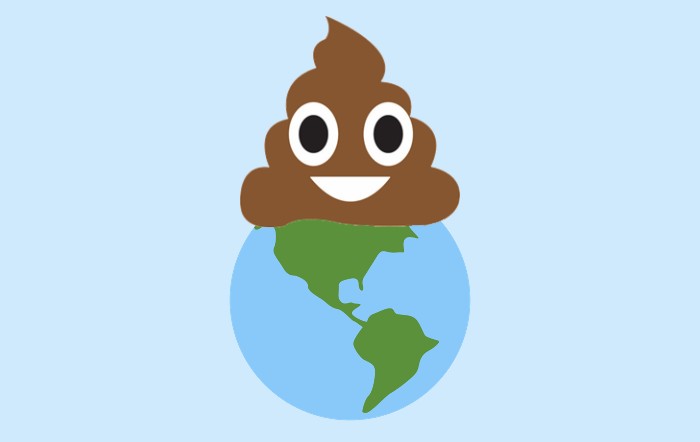
The answer is pretty simple. Don’t shit where you eat. Seriously.
We’re getting better, but we’re still shitting up the place. We “eat” (consume) from air, land and water. Yet, we’re shitting up the air with emissions; we’re shitting up the land with trash and chemicals, and we’re shitting up the water with even more sludge. In all of our personal and industrial practices, we should be aware of exactly what we’re shitting up.
I took a trip to Florida when I was fourteen years old, and my friends and I took a swamp-boat tour of the Everglades run by a tribe of Native Americans on their reservation, and afterward we got to talking about it. For time immemorial, the tribe had sustained themselves off of the fish and vegetation harvested in the Everglades, but due to industrial development in the neighboring communities all around them, the water had turned toxic, and the food supply was no longer fit to eat, forcing them to try to make money to buy food from elsewhere. This is why they started up the tour business.
This isn’t just an example of one group of people fucking over another group of people. In the larger context, this is an example of humans fucking up humans’ food supply. And, we do it all the time. Just stop it already.
Be selfish
Look, if you want to join the wolf in crying to the blue corn moon, that’s cool with me. If you want to literally hug a tree, that’s cool with me, too. If you want to personify and then make mad passionate love to Mother Earth, that’s fine. But none of that is necessary. All you have to do is be selfish.
In the short term, selfishness may encourage you to devastate the earth around you for immediate profit. But, to continue the metaphor, think of sustainability like your retirement plan. Short term gains can sacrifice long term wealth. By developing sound, sustainable practices now, you can ensure you won’t crash and burn later. Enduring the minor inconveniences of a green lifestyle (recycling, conservation, safe disposal of waste) will save you and the rest of humanity a whole lot of pain later. Invest in the future so that there will be a future.
Humanity doesn’t have to save the Earth. Humanity has to save itself. To do that, stop shitting where you eat.