It’s funny how current events shape how we look at the past. When we write, when we’re trying to be completely honest, we choose events and attitudes to write about, singling them out from the rest of our experiences, making a touchstone of them. But, the progression of time changes how we think and feel about things, and when I look back at some things I have written, I think to myself, “What the hell was I thinking?”
Suddenly, things that were written in the attempt at honesty seem the least honest of all. I start to question what my motives were in writing, investigating what I was trying to accomplish by representing things in a certain way.
The essay below is a prime example. It has gone through several changes over the years. When I originally wrote it, it had a conciliatory manner. Though the facts remained intact, the interpretation of those facts was optimistic, apologetic, sympathetic. Revisiting it again a couple of years later, circumstances had changed my point of view, and this was rewritten, the hopefulness removed, and sardonic malevolence inserted in its place.
Later, that seemed less than honest, too. How can someone revise what was written, erasing the sentiment that was originally intended? Is it honest to deny how one felt at a certain point in time? The essay went through another sort of transformation, landing somewhere in the middle. To this day, I cringe at its lack of spite, absence of pungent bitterness, even though it is no summer day as it is. However, I’m going to leave it alone now, for fear of being disingenuous. Prose is like a time capsule, I suppose. The world is never the same place when you dig it up.
• • •
My father and I never had one of those gel-coated, easy-to-swallow relationships. Every attempt at ingestion resulted in the whole damned thing lodging painfully somewhere between our mouths and our hearts. And, nothing we ever did made it go down any easier. We would close our eyes, and plug our noses, an attempt to avoid the bitter awareness of the unbearable expectations of our respective roles. We would try to wash everything down with fishing trips and outings to look at yachts we couldn’t have, but the results were always the same. We just didn’t get along as father and son.
Mutual perfection was the only conceivable solution, demanding conformity of each other around every turn—a solution that was fine in theory, but impossible in practice. My father never claimed to be perfect; his only claim was fatherhood, a term that biblically demanded ultimate respect and submission, and one of the first religious tenets that I refused to accept. Perfection, or at least near-perfection (claiming human fallibility only when fucking up in such a way that justification was out of the question), was something that I did claim, and am now, for perhaps the first time, admitting the contrary.
In my eyes, my father could do no right—each virtuous action was haunted by the ghosts of failures past. Every time he hugged me, told me he loved me, complimented me, or encouraged me, I waited tensely for the other foot to fall, with me left vulnerable underneath. The Bible says that love covers a multitude of sins, and I believed that everything he did that resembled what fathers are “supposed” to do was a play to cover the scads of “sins” that he was sure to commit in the near future—a sort of insurance plan.
My father shot from the hip, as opposed to taking calculated aim in any given situation, and I was always caught in the crossfire. If he had been William Tell, I’d have been dead. He did what first sprouted in his mind, rather than carefully reasoning out a situation; and I resented all of it. Having no faith in intuition, I demanded explanation for every decision, but was satisfied with none given. I was the child that no parent wishes upon himself or herself. There were times as a child, as a youth, and as a young adult when I actually believed that I was put on Earth to bring to justice the arch-villain that was my father. I was foolish in that way.
• • •
It’s bizarre what one remembers from childhood. Many of the events one might site as a milestone in a child’s life are wasted on me. I don’t remember my first basketball game. I don’t remember my first day of school. It’s the small things, the individual moments that stay fresh in the recesses of my head. I remember the time I swept my babysitter’s driveway, the time I dipped a flashlight in a cup of root beer to see if it would glow, the time I wrote my initials on the side of my nightstand drawer, and the time I tried to pick myself up clear off the ground and hold myself in the air—a trick that I still seem to believe I can do when there’s no one else to carry me. A few years ago, in a random conversation with a friend, I recalled an event, or part of an event, from the days when I was short that made me realize a particular trend in my relationship with my father growing up.
• • •
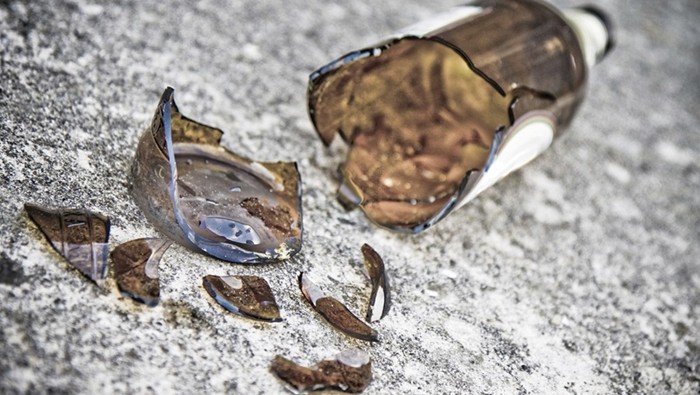
It was another cold rainy Seattle afternoon in August, and I was six years old. Relieving young male aggression alongside my neighborhood friends, I was participating in a common ritual in a roadside ditch. Brian, Andrew, Timmy (all brothers), and I were smashing glass beer bottles, of which there was always an ample supply with an equal supply of rocks conveniently located in the ditch.
The way a boy feels in this act of destruction is almost inexplicable. This was a way to feel powerful, a way to feel significant in a world in which we were generally overlooked and disregarded. We took the remnants of someone’s innovation and someone else’s consumption, and shattered it to pieces. The bigger the rock, the louder the crash, the smaller the shards, the better we felt about ourselves. We’d whoop and holler at the demise of a bottle the way grown men do at their favorite team’s winning Superbowl touchdown, and throw our arms into the heavens the way grownups do in Pentecostal churches. Something inanimate and essentially non-threatening became our most loathed enemy during those hours spent on the roadside. But, as I found out, not every bottle was harmless.
I had just finished my thorough search of the ditch for a good-sized rock, and had discovered one on the embankment perfectly suited for my purposes. Smooth and round, it was slightly larger than a softball, and required some effort to lift and carry with my little arms. I hauled it down from the embankment into the bottom of the ditch, and immediately saw a large bottle caked with dirt. I stepped up to it ready to annihilate it, not bothering to call attention to myself among my friends. They would be sure to hear the thunderous crash. I stood over it, holding my rock, excited to see what would happen. Then, I dropped it.
The next couple of minutes are a blur. Instead of hearing the expected sound of a bottle being crushed into smithereens, I felt a heavy blow to the head, right between my eyes—the force knocking me down. My head began to pulse and throb the way it does when you bump your head against someone else’s. Finding myself on my back against the embankment, I sat up and put my arm to my head, burying my face in the inside of my elbow. I sat like that for a couple of minutes while I gathered my wits, hoping no one had seen what had happened. The bottle I had tried to break turned out to be made of plastic, and the cannonball I had lobbed at it, instead of breaking it, had bounced and taken its toll on me instead of its intended victim.
After I pieced these events together, I lowered my arm and looked around. There was the bottle, intact with the word “Pepsi” now visible after the dirt had been jolted off. Then, I saw my friends all looking at me, and the expression of terror on their faces frightened me. “Oh my God, I’m going to go get help!” Andrew screamed as he sprinted down the street in the direction of his house. Confused, I looked down and saw the green sleeve of my official school jacket stained black. I touched my face, my dirty fingers finding blood. I quickly buried my face in my arm again and waited for the grownups.
Pat, the boys’ mother, and a lady I didn’t know were there in a flash looking me over. “I think he’s going to need stitches,” the lady said. At this point, I panicked, and for the first time during this episode, I began to cry. I looked up, and through blood and tears, I could see the shape of my father walking toward us from the other end of the block where we lived. They must have called him. I didn’t even know they had my phone number. I was terrified more of my father than I was of my wounded head.
My father was unpredictable, and I never knew what would anger him, though it was a safe bet that anything would. Once, he thought I was mishandling our dog, to teach me a lesson, he picked me up by the arms, swung and jerked me around in the air by my arms and legs, and tossed me onto the doormat to lie like an animal for what seemed like hours. On another occasion, he severely spanked me for climbing into his gold Cadillac with traces of dirt on my shoes. And while these were isolated instances, and my father was not, generally, a physically abusive father, the frequency of all kinds of punishment and the occasional physical severity was enough to keep me constantly afraid.
I knew that bottle-smashing was not an activity condoned by our parents, and now, we had all been caught. I had stained my coat, which I wasn’t even supposed to be wearing outside to play in. It was a gray coat with green sleeves, and had the emblem of my private school on the front. My parents had had to scrimp and save to buy it for me in efforts to help me fit in at this school. They had already made great sacrifices in order to keep my enrolled. I was also afraid of being punished for being hurt, which is an enigmatic fear that plagues many young boys. But more, since we were dirt-poor and couldn’t really afford such luxuries, having to be taken to the doctor was horrifying, considering it was due to my own irresponsibility. I watched my father loom closer and closer, as the fear of what he would say or the punishment he would execute grew exponentially with every step he took. Then finally, after a few excruciatingly long minutes, he stood above me.
It’s funny; if he said anything, I don’t remember a single word. He scooped me up, and began walking home. I dangled limply in his arms, which to me at that moment, were the strongest arms in the world. I could hear his breath, and feel his chest swelling and shrinking more and more rapidly as we made the trek home. The whole feeling was unfamiliar since we were rarely carried. My sister and I would do everything we could to get him to pick us up. For some reason, it meant a lot to us to be wholly supported in the arms of our father. Often, arriving home at night in our car, we would pretend to be asleep, hoping that he would carry us in to bed; but even this ploy seldom worked. He would usually rouse us with a shake, and if unsuccessful, would end up leaving us in the car to our own devices. But now, caked with blood and dirt, he carried me down the block, into the house, and laid me on the floor with a couch pillow and a towel.
From there, I heard him in the kitchen calling my mother, calling the doctor, and calling my mother again. He would come in to check on me, and inspect the gash between my eyes. And, I do not remember a single word uttered—only his rough hands touching me out of charity and not hostility.
Again, he carried me, this time to the car. We picked up my mother at work, and drove to the clinic of our family doctor, known to me as Dr. K., a friendly old man with a warm smile. I never learned what his whole last name was. This time, they told me, it wouldn’t be Dr. K. who took care of me—a frightening thought by itself. The man who saw me was a strange doctor with cold hands. When the needle was brandished to give me a local anesthetic, my mother got woozy, and had to leave the room. But, my father was right there beside me the entire time, offering me his hand to squeeze whenever it hurt. I didn’t think I’d need it, but in the end, I worked his hand like a lump of dough. He didn’t seem to mind.
I got four stitches that day; and once removed, I had a healthy scar the shape of a crucifix. At times, I was proud of it. Other times embarrassed. Now, it is rarely and scarcely detectable, showing up only once in a long while when I’m overstressed or fatigued. Unfortunately, as my scar faded, so did my memories of my father as my hero, if only for a day. Adolescence proved to widen the schism between us, and intensify our distrust of each other. And, only once I was grown and living on my own, did we begin to stitch up the wound in our relationship. He has apologized a thousand times for all the years of bad parenthood—apologies that I never truly accepted or reciprocated. There are still scars.
• • •
Distance and reflection have allowed me to reevaluate my years growing up. My father and I genuinely just didn’t see eye to eye. He became my bitter enemy in my efforts to become independent. I strived to be better than him—to be fair, compassionate, competent, responsible and intellectual—but I tore him down to build myself up and pointed out his flaws to demonstrate my own perfection. But, what I didn’t realize was that everything I threw at him was hitting me as well. My life was formed around my unhappiness, and it kept me unhappy; bitter that the very thing I would prove a monster still had authority over me. I was blind to it all.
For a while, I began to see my father once every few months. We greeted each other as adults—and even as makeshift friends. We played games of pool, and discussed books we had read not in efforts to wash down that nasty pill, but rather for the pure enjoyment of it. Distance allowed us to be civil.
Though I often forgot it, on that day, while my father was carrying me home, I knew that he loved me. He loved me the way he knew how, the way that made sense to him, and I was usually too blind to see it. And, though there was a lot of shit to deal with, and our personalities clashed on a monumental scale, whenever I was in need, whenever I struggled—whether out of paternal duty or religious pride—my father was there to carry me home. And, now that I can recognize it, for that, I will always be grateful.