

About a decade ago, I was asked to participate in the selection process for the valedictorian of the graduating class at Klahowya Secondary School. Naturally, I jumped at the chance to spend a day with gifted and disciplined students who were vying for the beau ideal of special honors before continuing on in their lives after high school.
There were about half a dozen students eligible to be valedictorian. A group of panelists and I were asked to evaluate each candidate’s portfolio—a binder containing what the student believed was his or her best work collected from all four years in high school. We were given an hour to view the binders, which allocated about ten minutes to view four years’ worth of essays, projects and tests per student. I couldn’t give a thorough read of one paper in that time before being hurried along to the next student’s work.
We were then asked to evaluate each student’s future. The candidates were expected to have chosen a university, picked a major and a minor, outlined their course load for the next four years, and provided a detailed class schedule for their first year of college. This last part was called a “Thirteenth Year Plan.”
Lastly, we listened to short speeches by each candidate about the careers they would be pursuing and why they’d chosen that career. We heard stories like that of one girl who’d decided to become a doctor after spending time in the hospital with her dying grandmother. Each student had experienced some kind of “road to Damascus” moment that was pivotal in setting the trajectory of their lives to come.
I was genuinely impressed with each of these young men and women. They had worked hard, excelled inside and outside of the classroom, volunteered within their churches and other charitable organizations, participated in a bunch of extracurricular activities including sports teams and clubs, and had generally filled every minute of their available time over the past four years doing something productive. They were driven, disciplined, and earnest.
And my heart broke for them.
I dutifully cast my votes at the end of the day, but I didn’t feel good about it. When the guidance counselor who’d invited me to participate asked me for my thoughts about my experience, I couldn’t hold back.
These students had spent four years producing and compiling their best work into a portfolio that would only be given ten minutes of scrutiny. We’d been asked to evaluate the portfolio, but given only enough time to scan a few pages, suggesting that their work wasn’t important at all. We had listened to well-written and well-executed speeches about the future, but I objected to the nature of the subject matter. And this led me to my big point.
No teenager should be expected to know what they’re going to do with their lives.
College is a place of learning, but that learning goes far beyond a specific course of study. It includes learning about oneself. In college, you learn as much outside of the classroom as you do inside by way of exposure to myriad people and ideas that you’ve never encountered before. You experience new things, develop new likes and dislikes, and expand your point of view as you incorporate a wealth of scholastic, practical and philosophical knowledge, and as you consider the world with an ever-broadening context. College is a place of both academic and very personal discovery, and without yet having experienced college life, high school students are in no position to plot a course for the next four years.
Further, a student’s freshman year of college is anything but a “thirteenth year.” Anyone who has attended a university knows that it isn’t an extension of primary and secondary education. It’s a whole different world. It’s a world of adulthood, personal accountability and choices. It’s a world of exploration, expansion and revelation. It’s a world fundamentally different than anything students have experienced before graduation, and pretending that a high school student is equipped to chart their path does a disservice to the student.
I pointed out to the counselor that a large percentage of college students don’t graduate with the degree they’d intended when they entered college. Further, a large percentage of college graduates don’t end up in a career related to their degree. So, why were these students being asked to have everything figured out in advance? Teenagers just aren’t equipped with the experience or the wisdom to know what path they should take in college and their careers beyond.
At the time, my opinion was based on anecdotal and experiential evidence. Today, there is plenty of data to support that conclusion.
First, let’s look at the “thirteenth year” and selected majors. The National Center for Education Statistics recently published a report called “STEM Attrition: College Students’ Paths Into and Out of STEM Fields.” “STEM” stands for Science, Technology, Engineering and Math, and the report focuses on the results in those fields, however it presents data in non-STEM fields as well. Among many conclusions, this report shows how many students either leave college or switch majors before graduating in a degree program.
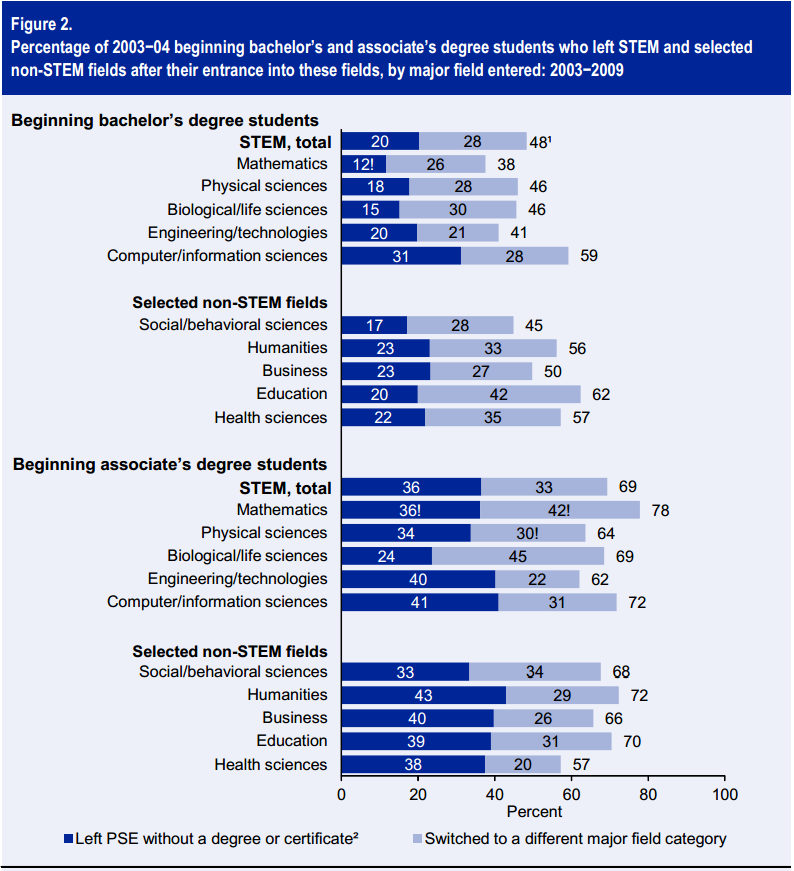
Among students who started college in the 2003-04 school year, many had either left school prior to graduating, or had changed their major. Among bachelor’s degree students, 28% of students who initially majored in STEM fields had abandoned the major in favor of something else. Social sciences lost 28%, Humanities lost 33%, Business lost 27%, Education lost 42% and Health Sciences lost 35% of their students to other fields of study.
According to this data, the median rate of dropout is 20%, the median switch of majors is 28%, and the combined median rate of students who do not graduate in their initial field (whether by leaving college or switching majors) is 48%. Those figures are even higher among students in associate’s degree programs.
But, let’s say they persist—they get a degree and head off into the workforce. Do they like the field they’ve chosen?
In May of 2013, authors Jaison R. Abel and Richard Deitz published a study through The Federal Reserve Bank of New York that showed that only 62% of college graduates landed in a job that even required a college diploma. Further, only 27% of college graduates worked in a field related to their college major.
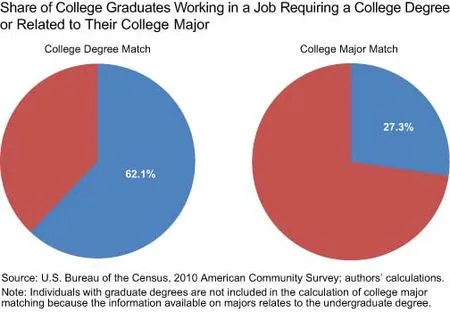
But, this is due to the economy, right? Aren’t college grads just having trouble finding a job in their chosen field? Yes, that’s a large part of it. But let’s look further. Specifically, let’s look at educators.
While the recession has led to widespread layoffs in education, resulting in a surplus of teachers vying for too few available jobs, that trend is sure to turn around as Baby Boomers begin to retire, who currently make up half of all teachers in the US. What I find more fascinating is the number of teachers who realize that teaching just isn’t their cup of tea once they try it. In her article “Building Better Teachers“in the September 2014 issue of The Atlantic, writer Sara Mosle reports that “Among novice teachers, who constitute an increasingly large proportion of the remaining workforce, between 40 and 50 percent typically quit within just five years, citing job dissatisfaction or more-alluring prospects.”
While teachers aren’t necessarily the “canary in the coal mine” for all industries, it’s certainly a testimonial to what can happen if someone chooses the wrong career. If people are ditching the careers that they studied so hard to prepare themselves for, how are high school students expected to have it figured out in advance? Research suggests that they haven’t yet achieved a level of maturity conducive to deciding about these things.
In their book How College Affects Students published in 2005, authors Ernest T. Pascarella and Patrick T. Terenzini write:
The small body of evidence from the 1990s is consistent with our 1991 conclusion that students become more mature, knowledgeable, and focused during college in thinking about career. Furthermore, there is also evidence to suggest that college seniors have a more accurate perspective about labor market realities and a higher level of overall workplace readiness than do their counterparts with less exposure to postsecondary education. It is hazardous to attribute these changes and class differences to the college experience itself, however. Simple maturation, the increased pressure on seniors to reach closure on career decisions, or the loss of the least able students from upper-division samples may be equally valid as competing explanations for the findings.
In fact, more recent research suggests that teenagers’ brains have not yet developed fully. During the teen years, neural networks are at a high and gray matter is expanding, allowing adolescents to learn new things at an astounding rate. Many attribute this fact to the urge to have new and novel experiences and the common impulsive behavior. According to the National Institute of Mental Health:
In terms of sheer intellectual power, the brain of an adolescent is a match for an adult’s. The capacity of a person to learn will never be greater than during adolescence. At the same time, behavioral tests, sometimes combined with functional brain imaging, suggest differences in how adolescents and adults carry out mental tasks. Adolescents and adults seem to engage different parts of the brain to different extents during tests requiring calculation and impulse control, or in reaction to emotional content.
However, the cortex is still developing, and it does so from back to front. During the teen years, emotional reactions are heightened in urgency and intensity. But, the frontal lobe associated with wisdom has not yet come fully online.
In the September-October issue of Harvard Magazine, Debra Bradley Ruder reports on fMRI studies of the teen brain conducted by doctors Frances E. Jensen and David K. Urion:
Human and animal studies, Jensen and Urion note, have shown that the brain grows and changes continually in young people—and that it is only about 80 percent developed in adolescents. The largest part, the cortex, is divided into lobes that mature from back to front. The last section to connect is the frontal lobe, responsible for cognitive processes such as reasoning, planning, and judgment. Normally this mental merger is not completed until somewhere between ages 25 and 30—much later than these two neurologists were taught in medical school.
So while a teen’s brain is wired to learn and to seek out new experience (exactly what college provides), it is not yet primed with sound judgment to make long term plans (exactly what students are expected to do when first entering college).
In my view, there is an easy solution to all of this, and I wish not only those valedictorian candidates but rather all students were nudged in this direction: explore.
In every bachelor’s degree program, there are a bunch of “basic and breadth requirements.” These are the Math, English, History and Science credits that every student needs to fulfill. Students should spend the first two years loading up on those classes, but also taking some elective classes that just look interesting. Scan through that list of 101s for whatever jumps out at you. Introduction to Acting? Sure. Introduction to Communications? Do it. Introduction to Statistics? Absolutely. Introduction to Philosophy? Go for it.
Intro classes not only prepare students for advanced classes, but they’re a great way to dip their toes in the water to see if they want to plunge in.
By the time a student is required to declare a major, they’ll have cleared the board of the required classes and will have been exposed to many other things that may have inspired them to pursue a career in one of those fields. At the same time, brain maturity will have further developed, enabling students to more effectively choose a direction in life.
The statistics about students switching majors demonstrate that many aren’t sticking with that initial decision, which I think is great. But by not prodding students during the high school-to-college transition to make up their minds so early, young people can be spared a lot of stress, allowed to find what will truly make them happy, and potentially help them pursue a career with both intrinsic and extrinsic benefits.