It was the worst thing she could do. You couldn’t exactly blame her—she was just trying to be a good mother. She was just trying to patch what had been torn, to fix what had been broken. But never having been a six-year-old boy, she was ignorant of the social and psychological significance of such matters of consequence. She just didn’t understand.
I stared at my knees, quiet and in mourning. It was as if all of my endeavors, my conquests, my adventures had been taken from me—destroyed by the unwitting benevolence that only a mother can inflict upon a boy. My badge of courage, of sorts, was worse than gone, it was covered up. Right there, where yesterday had been big beautiful holes in the knees of my well-worn jeans, now there were dark blue patches of new denim. I could have cried.
My jeans were like an autobiography; by looking at them, you could gain great insight into my life. There were grass stains telling of many victories and defeats in various back-yard sporting events. There was pitch and sap from a multitude of evergreens that I had climbed. There was grease from bike chains, ketchup from hot dogs, and mud from the flower garden where instead of weeding, I dug long elaborate canals to fill with water from the garden hose. There were always stains from one thing or another, and my mother diligently removed them as quickly as they appeared. But, the stains weren’t such a big deal. They were easily gotten, and easily replaced once removed.
Holes are a different matter altogether. Holes are more of a long-term investment. Any given stain told only of one event, one moment in a life that could be anything. But holes signified a lifestyle, symbolized a personality that was constantly on the go, risking perils, seeking achievement, oblivious of petty inconveniences. Holes embodied the essence of a boy’s undaunted character, his spirit of adventure, his devil-may-care approach to action and risk.
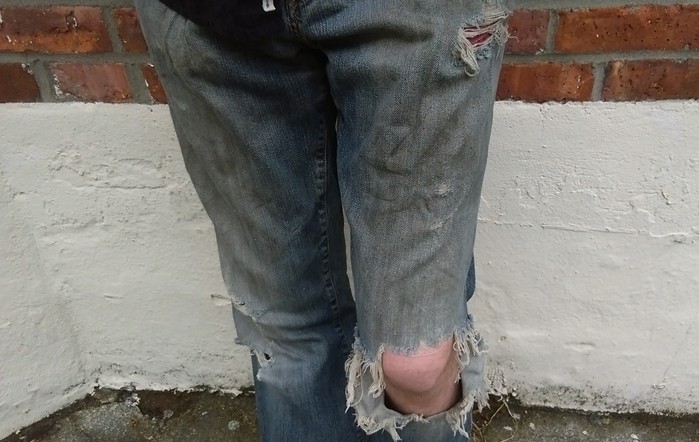
A basic tear in your jeans was all right, but not while it was still a crisp, clean tear. It would get cool after a few days or a couple of washes when the edges frayed. Better than a tear was when the knees of your jeans just wore out. You’d notice the fading at first. Eventually, the fabric would get really thin, and ever so slowly, a hole would start to form. You’d pick at it, encourage it, nurture it and cultivate that hole like a flower destined to win a blue ribbon at the County Fair. Eventually, you’d have beautiful holes spanning the width of your knee, with unbroken threads bridging the gap. Finally, those threads would break too and hang from the edges like icicles, leaving your knees exposed to the elements, ready to take on all the cuts and scrapes that earn envy and respect among your peers.
As a six-year-old, the holes in my jeans were a source of pride, the reward of a life well-lived, the battle scar gained from a hundred campaigns. And, unfortunately, my mother thought it prudent to cover them right up.
You see, my mother was a card-carrying member of adult society. She knew that having clothing in disrepair was a sign of either poverty or bad parenting or both. What she didn’t realize was that in pre-adolescent culture, holes in jeans were a status symbol—an inverse gradation of class compared to the world of grown-ups. When I was six years old in 1982, pre-manufactured holes were still a couple of years away. To grown-ups, they weren’t yet fashionable; and to kids like me, holes still had integrity.
As I grew older, I was conditioned to be embarrassed by these marks of distinction. I became civilized—even downright sophisticated—which, in adult society, meant to maintain the appearance of idleness. Dirty hands, scraped knees, and torn clothes constituted someone as a lowbrow in our Western socioeconomic caste system. When the knees of my trousers faded, I thought of the money it would cost to replace them, long before holes were even a possibility.
In the last few years, fashion trends moved toward the worn look. Whiskering, targeted fading, and full-blown holes started appearing on the jeans in department stores and specialty retail shops all over the place. On one hand, it’s a welcome move toward a relaxed attitude about the state of our clothes—the bourgeois are now practically indistinguishable from the proletariat as far as blue jeans are concerned. On the other hand, though, buying jeans that were worn out by machines leaves me wanting a bit. You’re paying extra for the damage without getting the pride of having caused that damage yourself through an active lifestyle—you’re a poseur.
Now, I continue to wear my jeans long after they’re “worn out.” My jeans consistently develop holes in the back pockets from my phone, my keys, from everything else I jam in there until the holes are big enough to render the pockets worthless. And still I wear them. I’m loyal like that.
Occasionally, someone will tell me that I need some new jeans, or a new jacket, or new shoes; and I patiently explain to them that I definitely do not. A girlfriend once said to me, “Hey Doug, Jesus called and he wants his sandals back.” I told her, “I’m not going to get rid of you when you get old and ragged, so lay off my sandals.”
Now that I’m in the second half of my 30s, when I have the misfortune of tearing my clothes or when holes appear, I notice a smile start to form on my face, and I look with pride at the wear-and-tear. That was a job well done.